

Pharmaceutical
Product classification
Contact us
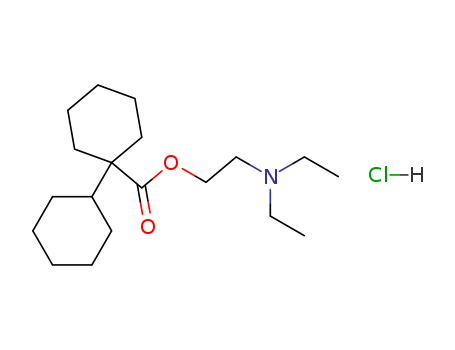
Cost-effective and customizable DICYCLOMINE HYDROCHLORIDE 67-92-5 supplier
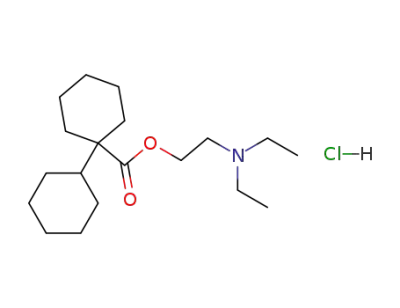
- Molecular Formula: C19H35 N O2 . Cl H
- Molecular Weight: 345.953
- Vapor Pressure: 1.34E-06mmHg at 25°C
- Melting Point: 164-166°C
- Boiling Point: 399.8°C at 760 mmHg
- Flash Point: 116.5°C
- PSA: 29.54000
- LogP: 5.20420
DICYCLOMINE HYDROCHLORIDE(Cas 67-92-5) Usage
|
Manufacturing Process |
155 grams of 1-phenylcyclohexanecyanide, 350 cc of concentrated sulfuric acid and 1,130 cc of ethyl alcohol are refluxed vigorously for 48 hours. The remaining alcohol is then removed by vacuum distillation and the residue is poured into 1 liter of ice water. An oil separates which is extracted 3 times with 200 cc portions of petroleum ether, the extracts are combined and heated on a steam bath to remove the ether. The resulting crude ester may be used directly for the reesterification operation or it may be distilled to purify it first. A mixture of the ester so obtained, 155 grams of βdiethylaminoethanol and 800 cc of dry xylene are placed in a reaction vessel with about 2 grams of sodium. The vessel is heated in an oil bath at 150°- 160°C. A xylene-ethanol azeotrope distills over at about 78°-82°C over a period of 2 to 3 hours. The distillate is cooled and shaken with about 3 times its volume of water, the decrease in volume of the distillate being considered a measure of the amount of alcohol formed. When 80-90% of the theoretical amount of alcohol is obtained in the distillate the reaction mixture is subjected to vacuum distillation to remove most of the xylene and unreacted diethylaminoethanol. The residue is poured into 500 cc of benzene which is then extracted 3 times with 500 cc portions of water.The washed benzene layer is diluted with an equal volume of ether and alcoholic hydrochloric acid is added until the mixture is acid to Congo red. A white crystalline solid forms which is dissolved in 300-400 cc of alcohol and diluted with ether to the point where precipitation starts. A few drops of butanone are added, the solution is cooled to -10°C, and filtered to recover the crystals which separate. The product is obtained in the form of white needles melting at 159°-160°C, in good yield. 13 parts of β-diethylaminoethyl 1-phenylcyclohexanecarboxylate hydrochloride, 125 parts of glacial acetic acid and 0.3 part of Adams' catalyst are heated to 70°C and shaken with hydrogen at 50 lb pressure until 90- 100% of the theoretical hydrogen is absorbed. The acetic acid is then removed by distillation and the residue recrystallized from butanone, giving the above product as a crystalline hydrochloride melting at 165°-166°C, in good yields. This product may also be prepared by reacting cyclohexyl bromide with cyclohexyl cyanide with the use of sodium amide followed by alcoholysis and reesterification. |
|
Therapeutic Function |
Spasmolytic |
|
Safety Profile |
Poison by intravenous route.Moderately toxic by ingestion. Human systemic effects byingestion: rigidity, dyspnea, cyanosis. When heated todecomposition it emits very toxic fumes of HCl and NOx. |
|
Definition |
ChEBI: The hydrochloride salt of dicyclomine. An anticholinergic, it is used to treat or prevent spasm in the muscles of the gastrointestinal tract, particularly that associated with irritable bowel syndrome. |
|
Brand name |
Bentyl (Axcan Scandipharm). |
|
General Description |
Dicyclomine hydrochloride,2-(diethylamino)ethyl bicyclohexyl-1-carboxylatehydrochloride (Bentyl), has some muscarinic receptorsubtype selectivity. It binds more firmly to M1 and M3 thanto M2 and M4 receptors.76Dicyclomine hydrochloride has one eighth of the neurotropicactivity of atropine and approximately twice themusculotropic activity of papaverine. This preparation, firstintroduced in 1950, has minimized the adverse effects associatedwith the atropine-type compounds. |
InChI:InChI=1/C19H35NO2.ClH/c1-3-20(4-2)15-16-22-18(21)19(13-9-6-10-14-19)17-11-7-5-8-12-17;/h17H,3-16H2,1-2H3;1H
67-92-5 Process route

-
-
67-92-5
dicyclomine hydrochloride
| Conditions | Yield |
|---|---|
|
2-Diethylaminoethyl-1-phenylcyclohexancarboxylathydrochlorid, Rh/Al/Eisessig, Hydrierung;
|
Related products
-
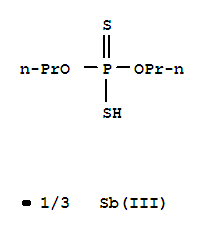
antimony tris[O,O-dipropyl] tris(dithiophosphate)Detail
CAS:15874-48-3
-
AminoacylaseDetail
CAS:9012-37-7
-
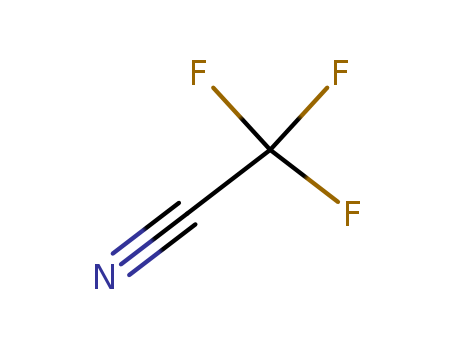
TrifluoroacetonitrileDetail
CAS:353-85-5
-
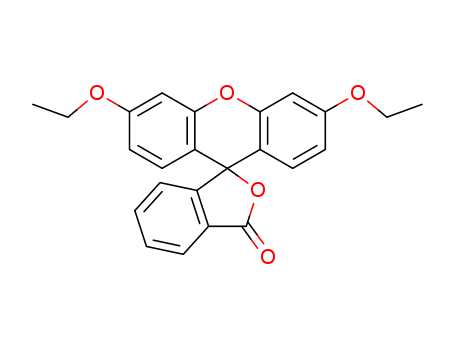
3',6'-diethoxyfluoresceinDetail
CAS:21934-70-3